
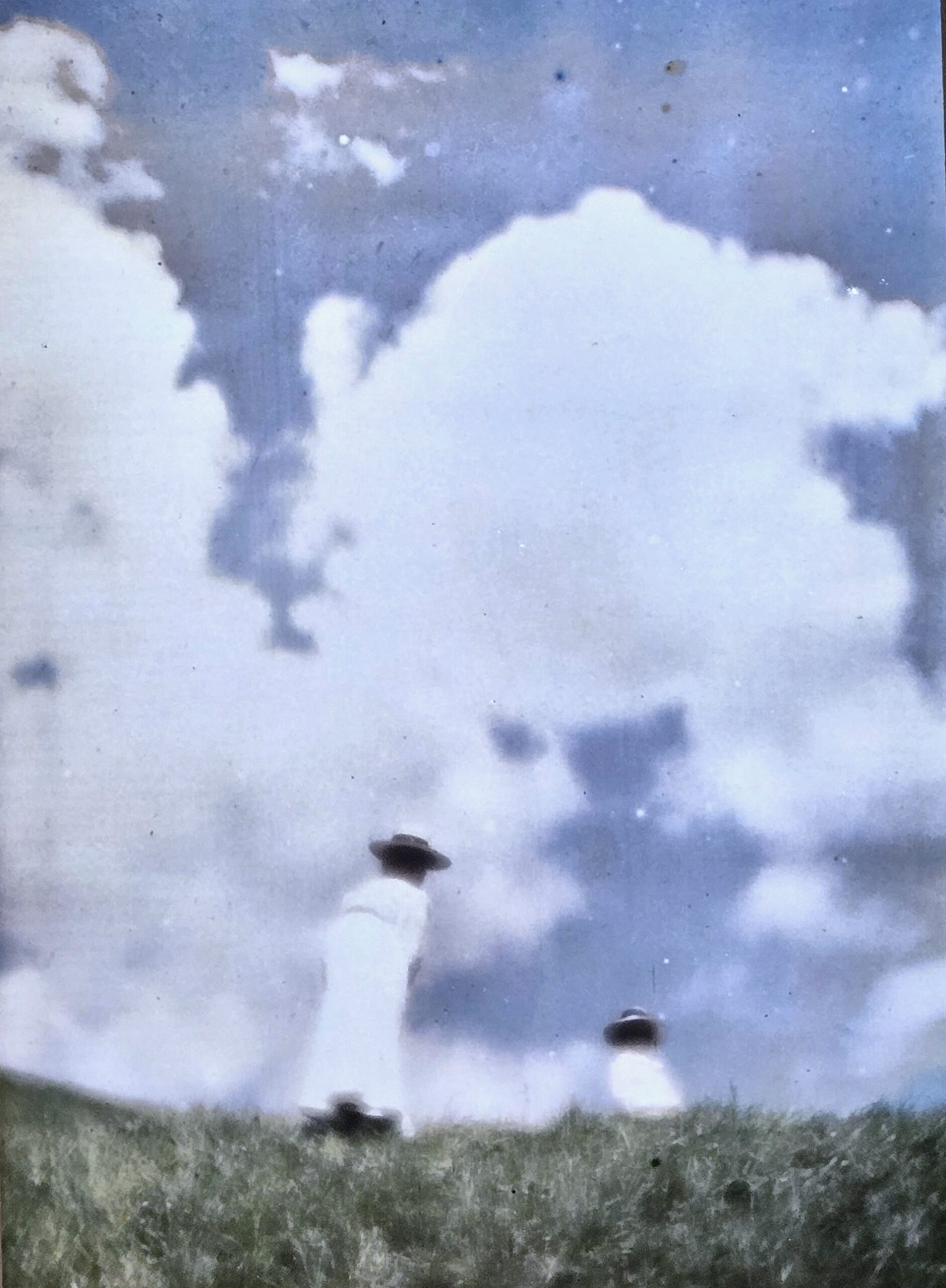
Heinrich Kuhn (Austrian, 1866-1944) – Mary Warner and Edeltrude on the Brow of a Hill, ca. 1908. Digital facsimile of original autochrome. Gilman Collection, Purchase, Mrs,. Walter Annenberg and the Annenberg Foundation Gift, 2005 (2005.100.370)
*
Sunday, 10:05 a.m., October 11th, 2026 – On an (appropriately) cloudy-grey day, just after the Museum opened, I found the Howard Gilman Gallery, tucked away past a long parade of drawings, prints and photographs, around the corner from the second floor corridor; before the crowds arrived, I wanted to walk in solitude through the cloistered rooms to survey this highly-anticipated show, assembled with discernment and panache by Stephen C. Pinson, Curator in the Department of Photographs.
Chasing Clouds, he writes, in the first of many exquisitely-composed wall texts, “presents this story of the sky as a contested realm of representation. Opening with oil sketches from the start of the nineteenth century, it comes full circle in the 1920s with American photographer Alfred Stieglitz’s Equivalents, a series of cloud photographs that reconciles poetic feeling and naturalistic depiction.”
John Constable (1776-1837), familiar pioneer of the persistent en plein air practice he called “skying,” is represented by a selection gleaned from hundreds of cloud studies. Pinson directs our attention to the artist’s rapidity of composition in order to “capture the sun.” The speedy application of watercolor over a pencil sketch lends an aura symptomatic of the artist’s pursuit of elusive perfection in nature, residing at the core of the aptly named Romantic movement.
In contrast, my eye is drawn to St. Peter’s Seen From the Pincio, Rome, made in 1856 by Henri-Joseph Harpignies during the transition to the rudimentary art-science of photography. Pen and black ink mingle with grey and blue washes to evoke “overcast, gloomy” heavens. At the midpoint of the elongated scene, abiding by the limitations to the artist’s palette, the Church spire punctuates a chiaroscuro skyscape.
It was difficult to choose an illustration for this essay from the embarassment of riches in Chasing Clouds. I finally came back to Pictorialist Heinrich Kuhn‘s ethereal “autochrome.” The artist, unseen, approaches deftly uphill, through the grass, to watch his little daughter, Edeltrude, accompanied by the family governess.
Pinson explains that autochromes “are positive glass transparencies…illuminated from behind…their color derived from thin washes of tinted potato starch.” Such weightless hues, seeming to embrace two dreamlike wraiths beneath a sheltering sky!
The exhibition’s deliberate narrative comes around, as Pinson foretold, from John Constable‘s 1836 declaration that “painting should be understood…[not] only as a poetic aspiration” to a startling array of Alfred Stieglitz’s Equivalents, ranging from 1922-1934, “through clouds,” he wrote,” to put down [his] philosophy of life — clouds were there for everyone.”
Standing in contemplation of these mystique-infused photographs, I am reminded of Wassily Kandinsky‘s insistence upon “non-representation” in his early abstract paintings, likewise understanding that Equivalents take no relationship to the ground, or conventional depth of perspective. These pictures are documentaries of feelings, positioned to align with Stieglitz’s undeclared contemporaneous emotions.
*
Chasing Clouds is made possible by The Robert Mapplethorpe Foundation, Inc.
It remains on view in Gallery 852 at the Metropolitan Museum of Art through February 28, 2027.